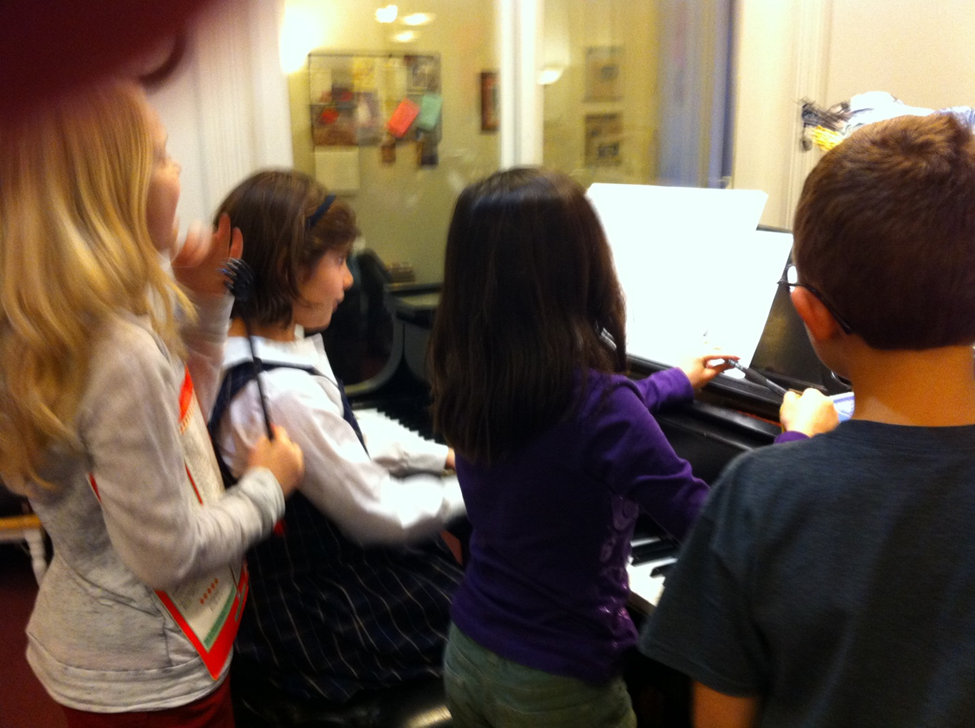
Students enjoy singing and playing holiday songs together in their lesson.

For many years, we have eagerly anticipated attending our good friends’ annual Christmas party. It was a much appreciated opportunity to catch up with friends from years past. The dazzling tree, ablaze with over 1,000 lights and more than 600 traditional glass ornaments was always a spectacle. A highlight of the evening was to see who could find the special ornament using only a few scant clues.
Midway into the evening, after everyone had their fill of goodies from the buffet table, and settled in with a relaxing beverage, we would launch into a sing along, accompanied by me on the piano. This is a tradition that adds a good deal of emotional connection and merriment to the festive holiday evening.
Last fall, Reno and I had some people over to our house to sing songs from musicals, a genre of music we and a few of our friends particularly share a passion for.
Occasionally, a teenage or pre-teen student will tell me about a party they attended where they spontaneously sat down and began to play the piano or instigated a sing along of favorite pop songs.
In the studio, we send the message to students that they can use their musical gifts to add to the fun of a party by encouraging a sing along and contributing live music. I let them know that the holiday season is a perfect time to try this, as the songs are so familiar to so many, and they will have participants of all ages willing to join the fun.
Here are some things we teach students to allow them to be ready to jump in and accompany no matter what their level of skill or readiness is. (It’s not a recital, it’s an opportunity to have fun!)
Keep going! In a familiar song, the singers will continue to sing if you get lost, and you can jump back in when you find your place or a familiar passage again.
For a traditional introduction that sets up both the key and tempo, play the last phrase of the song first. Then give a head nod to indicate when to begin singing.
Practice singing along to see if you really know the song well enough all the way through at the tempo you start at.
A song can be transposed by the pianist to find a comfortable key to sing in or play with other instruments which might need a particular key.
If you haven’t mastered two hands together, play one hand and invite a friend to play the other part with you. Even if you stumble along, it will be fun to try.
If the song has chords written above the notes, just play the right hand melody and the chord with your left hand. Or just play the chord and let the singers carry the tune if it is very familiar.
Play by ear (if you can) and fill in the left hand chords according to the formula we learn for which chords to use.
Finally, confidence comes from experience. Jump in and don’t worry about being perfect.
When our students start this activity at a young age, they are old “hands” at it by the time they are teenagers and adults. As their playing skills have reached more advanced
stages their confidence and poise for playing with or for a crowd has grown up with them and doesn’t have to play catch up.